 Guest Writer
 By Sophia Grace, Guest Writer
Somewhere between Melbourne and the South Australian border, the road stops being a route and becomes a reason. The Great Ocean Road — all 243 kilometers of it — is one of the world’s great drives, carved into cliffs by returned soldiers after World War I, hugging a coastline so dramatic it feels almost fictional. I drove it over three days in autumn, with a rented campervan, a cooler full of local cheeses, and absolutely no fixed agenda. What I found was not just one of Australia’s most iconic landscapes, but a food and wine trail that rivals anything I have experienced in Tuscany or Burgundy.
This article is your practical, personal guide to making the most of three days on the Great Ocean Road — where to stop, what to eat, which lookouts will actually leave you speechless, and how to slow down enough to let the place get under your skin.
Table of Contents
- Day One: Melbourne to Lorne — Surf Towns, Sea Baths & Smoked Fish
- Day Two: Lorne to Port Campbell — The Apostles, the Gorge & a Winery Picnic
- Day Three: Port Campbell to Warrnambool — Whales, Waterfalls & Warm Farewells
Day One: Melbourne to Lorne — Surf Towns, Sea Baths & Smoked Fish
Most people begin the Great Ocean Road at the iconic memorial arch in Torquay, about 95 kilometers south-west of Melbourne’s CBD. My advice: leave Melbourne early. The morning light on the Bass Strait is something you genuinely cannot manufacture, and the tourist coaches do not arrive until mid-morning.
Torquay itself is worth at least an hour. This is the birthplace of Australian surf culture — Rip Curl and Quiksilver both started here — and the main street has a relaxed, salty energy that sets the tone for everything that follows. Stop at Blackman’s Brewery, a cavernous local favorite, for a flat white and a pastry before you hit the road.
“The Great Ocean Road doesn’t reveal itself all at once. It makes you earn each view, one hairpin bend at a time.”
From Torquay, the road dips in and out of dense eucalyptus forest before emerging at Anglesea, a small town bisected by the Anglesea River. The kangaroos are everywhere — including, famously, on the local golf course. Pull over. Watch them. This is Australia doing what only Australia can do.
Your first major stop should be Aireys Inlet, home to the photogenic Split Point Lighthouse, which stands white and clean against the blue above the cliffs. Walk the short trail to the headland and stay for twenty minutes longer than you planned to.
By lunchtime, aim to be in Lorne — a town that manages the rare trick of being both popular and genuinely lovely. The Lorne Hotel has a deck overlooking the ocean and does a smoked trout open sandwich that I still think about. Lorne’s Sea Baths, a historic saltwater pool complex, are the ideal place to spend an hour in the afternoon before checking into your accommodation.
Lorne also makes a strong case for the overnight stop on night one. If you can manage it, book dinner at Movida Lorne — an outpost of Melbourne’s legendary Spanish restaurant — for a tapas evening that feels wildly incongruous and absolutely right, all at once.
According to Expert Market Research’s Australia Adventure Tourism Report, Australia’s adventure tourism sector was valued at USD 32.75 billion in 2023 and is growing at an 18.2% annual rate — driven in large part by travelers seeking exactly the kind of nature-immersive, food-rich experiences that the Great Ocean Road delivers.
Day Two: Lorne to Port Campbell — The Apostles, the Gorge & a Winery Picnic
Day two is the dramatic centerpiece of the drive, and it earns that status completely. Leave Lorne after breakfast and allow yourself to meander through the Otway Ranges — a stretch of temperate rainforest that feels entirely removed from the coast you have just been travelling. Pull into the Otway Fly Treetop Walk near Beech Forest for an hour among the tallest trees in the Southern Hemisphere. It is quieter than you expect, and the birdsong is extraordinary.
Rejoin the coast at Princetown, and the mood shifts instantly. The Great Ocean Road here enters Port Campbell National Park, and the landscape becomes something else entirely: vast, wind-scraped limestone platforms dropping sheer into a surf that has had the entire Southern Ocean to build its momentum. This is where the road earns its reputation.
“Standing at Gibson Steps, with seventy meters of golden cliff above you and the roar of the surf in your chest, everything else falls away.”
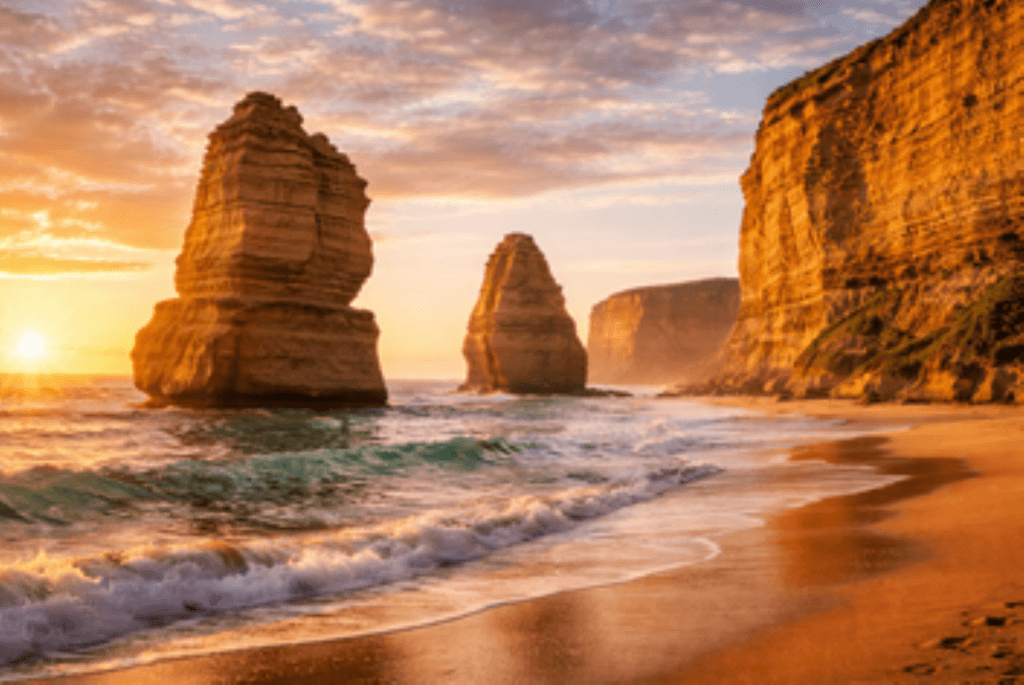
The Twelve Apostles need no introduction but deserve a visit regardless of how many photographs you have seen. Go at sunrise or sunset if at all possible — the midday light flattens them. Take the underground tunnel to Gibson Steps beach and walk along the sand looking up at the cliff face. Most visitors do not do this, and it is, frankly, the better view.
Nearby, Loch Ard Gorge tells a more human story: the wreck of the clipper ship Loch Ard in 1878, and the survival of its two young passengers. The gorge itself is a perfect oval of turquoise water ringed by cliffs, reached by a short walk from the car park. It is, if anything, more beautiful than the Apostles.
For lunch, detour slightly inland to the Apostle Whey Cheese artisan creamery at Timboon. They produce a range of small-batch cheeses using milk from local herds, and the tasting room is a revelation. Pair a cheese board with a bottle from Timboon Estate Winery next door — their pinot noir is exceptional — and eat outside on the grass. This is one of those meals that you realize, mid-bite, is becoming a memory you will keep.
End day two in Port Campbell, a small town perched on the clifftop with a handful of good restaurants. The Port Campbell Hotel has reliably good calamari and local fish of the day, and the beer garden looks out to the lighthouse. Go to bed early. Tomorrow finishes well.
Day Three: Port Campbell to Warrnambool — Whales, Waterfalls & Warm Farewells
The western end of the Great Ocean Road is less visited than the Apostles, which makes it one of the trip’s best-kept secrets. The limestone formations continue — the Bay of Islands, the Bay of Martyrs, London Bridge — but the crowds thin dramatically, and you will find yourself pulling over at empty lookouts to stand in the wind and feel, for a few minutes, entirely alone on the edge of a continent.
London Bridge is a must: two stone arches once connected to the mainland, now freestanding after the inner arch collapsed in 1990 (the tourists standing on it at the time were rescued by helicopter — thankfully without serious injury). It has a gallows humor to it that Australians appreciate.
If you are travelling between June and October, Logans Beach in Warrnambool is one of the only places on earth where you can watch southern right whales nursing their calves from a purpose-built viewing platform, free of charge, meters from the beach. I arrived at 8am on a still morning in May and watched a mother and calf surface and roll for nearly forty minutes. It was one of the most extraordinary things I have ever seen.
“A whale and her calf, twenty meters from shore, in the early light — some things cannot be planned, only stumbled into with gratitude.”
Warrnambool itself is a proper regional city with a good food scene anchored around the Warrnambool Farmers Market (held on the first Saturday of each month) and a cluster of cafes and restaurants in the town centre. The Gewürzhaus herb and spice shop is worth visiting for edible souvenirs, and Fishtales Warrnambool does the best fish and chips I found on the entire drive.
Before you leave, make time for Nigretta Falls and Wannon Falls, both a short drive north of Warrnambool near Hamilton. After three days of ocean, the shift to basalt gorges and tumbling freshwater falls is a reminder that Victoria’s landscape has more range than any single road can capture.
From Warrnambool, you can either retrace the Great Ocean Road eastward (which looks completely different in the opposite direction — trust me, do it), or continue west into the Grampians National Park for another adventure entirely. Either way, you leave with the particular satisfaction of a road trip done properly: slowly, attentively, and with good food at every stop.
Conclusion
The Great Ocean Road is, at its core, a road trip about patience. It rewards travelers who resist the urge to collect landmarks and instead allow each town, each beach, each coastal lookout to exist in its own time. Three days is the minimum; five would be better. But even three days, done well, will leave you with the particular ache that great places produce — the feeling that you have been somewhere real, and the suspicion that you left too soon.
Pack light, bring a decent cooler, and stop whenever the light looks interesting. The Great Ocean Road will take care of the rest.
Practical Notes
Best time to visit: March to May (autumn) for fewer crowds, mild weather, and whale season from June. December–January is peak tourist season.
Getting there: Fly into Melbourne (Tullamarine). Car rental from Melbourne CBD from approx. AUD 80–120/day. Campervans recommended for flexibility.
Where to sleep: Lorne (night 1) — Mantra Lorne or one of many excellent holiday apartments. Port Campbell (night 2) — Port Campbell Eco Beach Retreat or Port Campbell Hotel rooms.
Don’t miss: Timboon Farmhouse Cheese + Winery, Gibson Steps beach walk, Logans Beach whale platform (seasonal), Otway Fly Treetop Walk.
Author Bio:
Sophia Grace is a market research analyst specializing in industry trends, consumer behavior, and data-driven insights across sectors like food, chemicals, technology, and consumer goods. She focuses on turning complex market data into clear, practical content that businesses and readers can actually use.